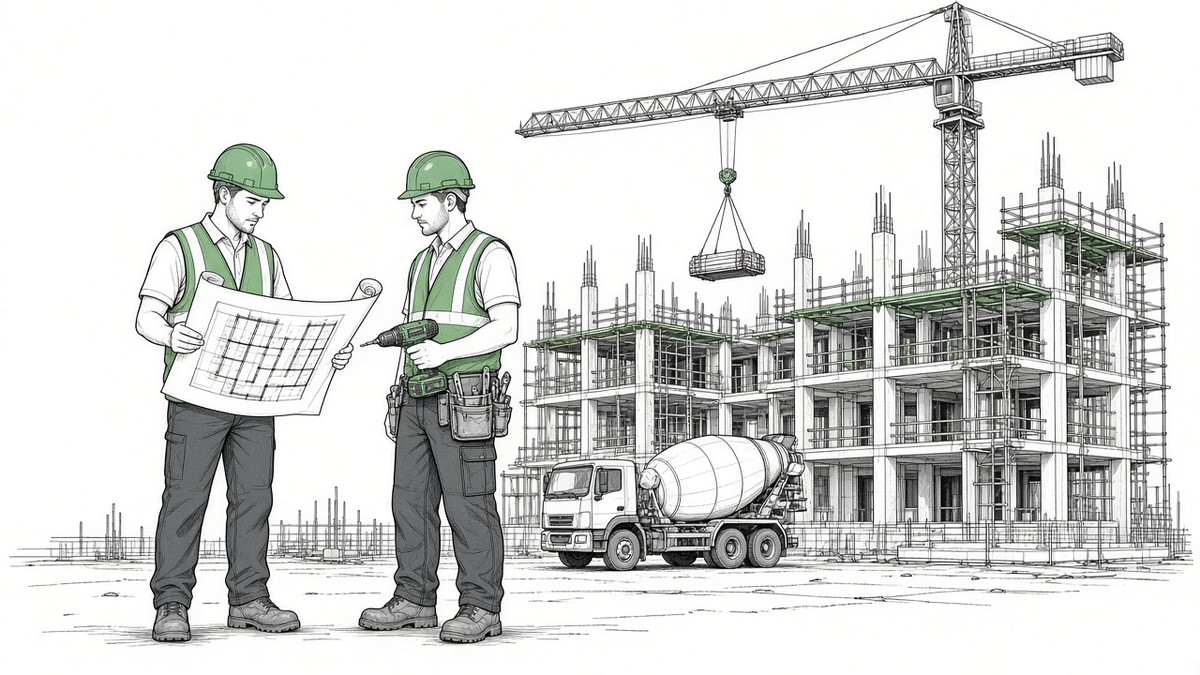
In construction and renovation, the work gets done today and the payment arrives much later. A subcontractor finishes a stage, submits an invoice to the main contractor and receives a post-dated cheque. Meanwhile there are materials to pay for, equipment to rent and workers to pay – and sometimes the next project to start. Cheque discounting for contractors can help you close that gap without waiting for the due date. In this article we explain how it works, which cheques we review and what to prepare in advance.
The cash-flow gap contractors and subcontractors face
Anyone in the trade knows the situation: the work on site is finished and the invoice is approved, but the cheque is dated another one, two or three months ahead. Expenses, on the other hand, don’t wait. The materials supplier wants to be paid, the workers need their wages and the equipment needs maintenance.
When you’re holding several post-dated cheques from the same main contractor or from different clients, a familiar picture emerges: on paper the business is profitable, but there isn’t enough money in the account for the coming weeks.
How does cheque discounting help?
With cheque discounting, you hand us a cheque you received for work you’ve done and get the money before the due date written on it. You’re paid at the time of the transaction – in cash, by bank transfer or on a prepaid card (according to the rules set out on this page). That way you can plan the project’s expenses around what you need, not around the dates on the cheques.
We review current and post-dated cheques up to 120 days for discounting. There’s no minimum and no maximum amount, so you can bring a single cheque or several together.
Why does the cheque writer matter so much?
The review focuses mainly on who wrote the cheque and the quality of the transaction, not only on your financial history. Subject to review and approval.
For a subcontractor, the cheque writer is naturally the main contractor, the developer or the client who ordered the work. So even if your business is relatively new, a cheque you received for real work can be reviewed for discounting. The decision is made for each cheque on its own merits.
What should you prepare?
Our representative will tell you in advance what to bring in your case. If you’d like cash, these are the rules:
- A cheque of up to ₪6,000 (inclusive) can be paid out in full in cash, with no need for an invoice, receipt or allocation number. The exemption covers the transaction documents only, not identification: for every transaction you need an Israeli ID card (teudat zehut) or a passport. For transactions over ₪50,000, also bring a second ID document: a passport or a driver’s licence.
- For businesses, a cheque over ₪6,000 and up to ₪25,000 inclusive can be paid out in full in cash against an invoice, a receipt and an allocation number (the number the Israel Tax Authority assigns to the invoice). For a cheque over ₪25,000, you can receive in cash the lower of 10% of the cheque amount or ₪6,000, against the same documents. For a cheque over ₪6,000, cash cannot be paid without these documents.
- Got several cheques? If each cheque is up to ₪25,000 (inclusive) and each has its own invoice and allocation number, plus a receipt as required, all of them can be paid out in cash, even if they’re from the same writer. When several cheques relate to the same invoice or allocation number, the cash limit is checked against their total.
- Anything above the permitted cash amount can be paid by bank transfer and/or on a prepaid credit card, up to ₪10,000 on the card. You can split it: up to ₪10,000 on a prepaid card and the rest by bank transfer.
Got an “account payee only” cheque from the main contractor?
Some main contractors mark their cheques “account payee only” (lamutav bilvad). When a cheque like this is made out to your business alone, we can’t discount it as it stands. The solution:
Got an “account payee only” cheque? Ask the person who wrote the cheque to put both names on it: “Pay to the order of [your name] or Y.D Amigo Ltd” (in Hebrew on the cheque: «לפקודת [your name] או י.ד אמיגו בע״מ»), and we’ll check it for discounting.
If you work with the same main contractor over time, it’s worth agreeing this wording with them in advance.
Tips for managing cash flow on a project
- Track your due dates: a simple table of all the post-dated cheques you hold, by date and amount, will show you in advance when you’re likely to run short.
- Decide which cheques to discount: you don’t have to discount all of them. You can choose only those whose due date is far off compared with your upcoming expenses.
- Agree things with the main contractor up front: if you know you’ll want to discount cheques, talk to them about the cheque wording as early as the invoicing stage.
- Keep your paperwork in order: invoices, interim invoices and work orders kept in one place save time every time you get in touch.
The process in brief
- Send a photo: photograph the cheque so that all the details are clear and send it to us on WhatsApp.
- Review: we review the cheque writer and the transaction.
- Answer and arrangements: we get back to you with an answer and explain what to bring.
- Payment: complete the transaction at our branch at Levinsky 52, Tel Aviv, or have our courier come to your business. At the branch, you get the money at the time of the transaction – in cash, by bank transfer or on a prepaid card (according to the rules set out on this page); through our courier – by bank transfer only, once the cheque reaches us.
We’ve been operating for 17 years, with more than 4,000 customers. You’ll find more about the service on our cheque discounting for businesses page.
Got a cheque from the main contractor? Send a photo of the cheque on WhatsApp and we’ll check it for discounting. For all the ways to reach us, visit our contact page.
Frequently asked questions
I’m a subcontractor with a new business. Can you review my cheque?
Yes. The review focuses mainly on who wrote the cheque, so a new business can also send a cheque for review.
Can I discount several cheques from the same main contractor?
Yes, you can bring several cheques together, and there’s no minimum or maximum amount. Every cheque is reviewed on its own merits. The cash rules for several cheques are set out in the “What should you prepare?” section.
How far ahead can the cheque be dated?
We review current and post-dated cheques up to 120 days.
How do I get the money?
At the branch – at the time of the transaction; through our courier – by bank transfer, once the cheque reaches us.
Nothing stated above is a commitment to provide credit. Final credit terms are set according to the specific terms of each customer’s transaction. Failure to repay the loan or the credit may result in late-payment interest and enforcement proceedings (Execution Office).
Credit provider licence – basic, No. 63112